  |
|
 HomePicturesTechnicalTournamentRecreationalFieldsStores HomePicturesTechnicalTournamentRecreationalFieldsStores |
|
|
Beginner InfoNews
And ArticlesLinksResourcesVideoContact
UsSearch |
| |
|
|
HomePicturesTechnicalTournamentRecreationalFieldsStores |
|
|
Beginner InfoNews
And ArticlesLinksResourcesVideoContact
UsSearch |
What
do you think?
|
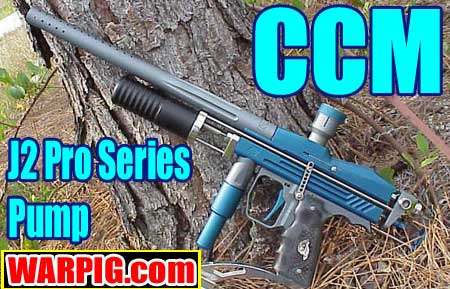
CCM J2 Pro Series Pump by Bill Mills Hailing from the Pacific Northwest, Chipley Custom Machine has been gathering a following that continues to increase. One of the things that drew early attention to the company was that owner Jason Chipley and members of his staff competed in the Pan Am Circuit and before that the Great Western Series tournaments with custom built CCM pump action paintguns.
While CCM produces parts for other paintball brands as well as their own accessory lines, they also build the J2 pro series paintguns. The J2 is available in both a pump and semi-auto verson, the model reviewed here is a J2 pro series pump. Whether semi auto or pump, these paintguns are based on the CCM J2 custom body. It may be tempting to call the J2 semi an Autococker and the pump version a Sniper because they work on the same principles and are compatible with many of the parts for a WGP Autococker or Sniper, but these paintguns are built by CCM from the ground up, and do not include WGP components or bodies.
In the top of the body is a sear lug depth adjustment hole. That’s a mouthful of a name, but it’s basically a hole that allows easy access to the top of the hammer inside the paintgun, making it easier to adjust the sear lug.
Added to the pump model for review was an auto-trigger. This cam and lever arrangement links to the pump arm and while the pump is back, keeps the trigger forward. When the pump is forward, it allows the trigger to be pulled. Thus by continually pressing on the trigger a player can make the J2 fire each time a pump stroke is completed. In the 1980s, auto-triggers were considered the high end of tournament firepower, able to unleash 3, 4 or sometimes more balls per second.
Instead of the pneumatics block used
on semis-, the pump version of the J2 has a pump mount on the front of
the receiver. It’s central rod supports the pump, while an additional
lower rod keeps the pump aligned. The pump itself features a metal
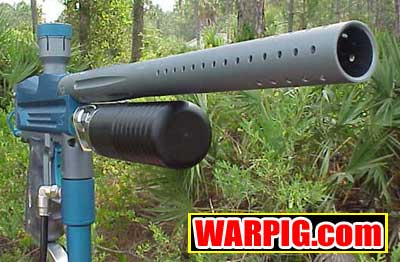
backplate and machined delrin pump body. Topping the J2 pump used for review was a CCM 14 inch barrel. With cosmetic grooves in the rear, a mirror finished interior, and porting over the last five and a half inches, the barrel is both well built and a good visual match for the rest of the gun. Looks are one thing, but performance is another. Probably one of the most notable features about the J2 reviewed was its smoothness of operation. Part of this must be credited to design, but some credit must also go to being broken in. The particular gun reviewed had been displayed at CCM’s booth at the 2002 Paintball World Cup in Orlando Florida, so person after person walking by would give in to temptation, testing out its action, smoothing out the contact surfaces the whole time. The pump stroke is approximately 1-1/4 inches in length, and so smooth that literally shaking the marker back and forward provides enough force to pump it.
For testing, the J2 pump was fitted with a Shocktech drop forward and ASA, connected with macroline to the vertical regulator. A 4500 psi Crossfire compressed air system was used with a fixed output setting of 800 psi. On the field, the velocity was low out of the box, but this was quickly taken care of at the chrono by adjusting the inline regulator, and then fine tuning with the velocity adjuster in the rear. The hex sockets in the adjuster are a very convenient feature, making time at the chrono station faster than the time honored tradition of having to pull out the cocking rod to adjust. Once dialed in, the J2 pump showed excellent velocity consistency. Accuracy both at the chrono and in game was excellent. Owing to the barrel venting, the J2 performed rather quietly, which was an advantage in woods games. One drawback to the J2 as a pump was the lack of a sight rail. Playing with a pump typically means taking more single shots, so more effort is spent on aiming than simply walking a string of shots to the target. The length of the 14 inch barrel was a help in this regard, allowing sighting down its side rather than over or through traditional sights. The action was smooth, as was the trigger release. Despite the author not having played with a pump action gun in quite some time, ball chopping and short stroking the pump were never a problem. When it came time to throw a larger volume of paint either longballed at a group of players, or to cut through some brush, the auto trigger definitely came in handy. While it increased rate of fire, this was at a noticeable decrease in accuracy. The accuracy change was not due to mechanical issues, but rather the difficulty of maintaining a constant aim on target while rapidly operating the pump. When it came to wanting tight shot groupings, it was best to slow down and take well aimed shots. Against a field of mostly lower cost blowback operated paintguns, the accuracy the J2 provided balance against the decreased rate of fire.
|
| Copyright © 1992-2019
Corinthian Media Services. WARPIG's webmasters can be reached through our feedback form. All articles and images are copyrighted and may not be redistributed without the written permission of their original creators and Corinthian Media Services. The WARPIG paintball page is a collection of information and pointers to sources from around the internet and other locations. As such, Corinthian Media Services makes no claims to the trustworthiness or reliability of said information. The information contained in, and referenced by WARPIG, should not be used as a substitute for safety information from trained professionals in the paintball industry. |
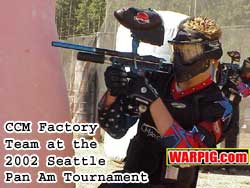 Not
only is it unusual to see pumps on the field against semi autos, but it’s
more unusual to see a whole team using them, and more than that a while
team using them well tournament after tournament, not just as a flash in
the pan.
Not
only is it unusual to see pumps on the field against semi autos, but it’s
more unusual to see a whole team using them, and more than that a while
team using them well tournament after tournament, not just as a flash in
the pan.
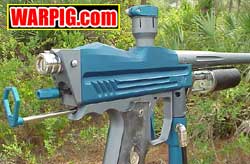
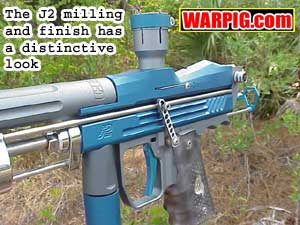 The
J2 body is of an angular design, and all of its accessories match its look
from the continuation of body cuts to overall contour. One of the
most striking features is the row of three fins that grow up out of the
back of the body and then are continued on the top of the cocking block.
The CCM components are all anodized over a bead blasted finish. This
gives the aluminum solid coloring with a matte texture.
The
J2 body is of an angular design, and all of its accessories match its look
from the continuation of body cuts to overall contour. One of the
most striking features is the row of three fins that grow up out of the
back of the body and then are continued on the top of the cocking block.
The CCM components are all anodized over a bead blasted finish. This
gives the aluminum solid coloring with a matte texture.
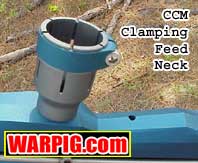 At
the front of the body are Autococker compatible barrel threads, and the
vertical breech accepts a variety of CCM feednecks. CCM’s feednecks
feature a reliable clamping design to firmly hold the loader in place.
The feedneck is cut into six sections, and a clamping band fits in a channel
at the top of the neck. A single hex head screw tightens the band
to secure the loader.
At
the front of the body are Autococker compatible barrel threads, and the
vertical breech accepts a variety of CCM feednecks. CCM’s feednecks
feature a reliable clamping design to firmly hold the loader in place.
The feedneck is cut into six sections, and a clamping band fits in a channel
at the top of the neck. A single hex head screw tightens the band
to secure the loader.
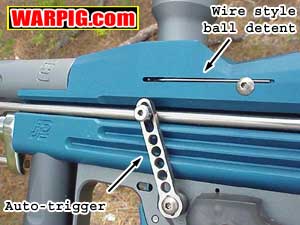 Rather
than ball bearing style detents the J2 body utilizes a wire style detent.
Wire detents were a fairly common modification for airsmiths to perform
to Autocockers in the early 1990s, before cockers included a ball detent
in their design. A wire detent prevents double feeding, but it gives
less resistance against the ball and bolt than a ball bearing style detent.
The fine horizontal milling needed to place a wire style detent in a body
makes this a more expensive design to manufacture.
Rather
than ball bearing style detents the J2 body utilizes a wire style detent.
Wire detents were a fairly common modification for airsmiths to perform
to Autocockers in the early 1990s, before cockers included a ball detent
in their design. A wire detent prevents double feeding, but it gives
less resistance against the ball and bolt than a ball bearing style detent.
The fine horizontal milling needed to place a wire style detent in a body
makes this a more expensive design to manufacture.
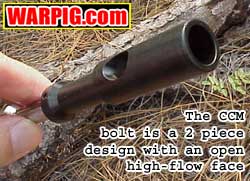 The
CCM bolt is a two piece design. The aluminum back half locks into
the cocking block while the front half is made of self lubricating Delrin,
allowing for slick operation. The bolt is of a high flow design.
Its face is basically hollow, with an angled back from the gas entry slot.
Rather than using a self locking pin like most similar bolts, the CCM bolt
has a spring loaded ball bearing in the bolt which locks to a groove in
the solid pin, much like the popular Shocktech Supafly bolt. This
design is more robust and durable than the small ball bearings used in
self locking pins.
The
CCM bolt is a two piece design. The aluminum back half locks into
the cocking block while the front half is made of self lubricating Delrin,
allowing for slick operation. The bolt is of a high flow design.
Its face is basically hollow, with an angled back from the gas entry slot.
Rather than using a self locking pin like most similar bolts, the CCM bolt
has a spring loaded ball bearing in the bolt which locks to a groove in
the solid pin, much like the popular Shocktech Supafly bolt. This
design is more robust and durable than the small ball bearings used in
self locking pins.
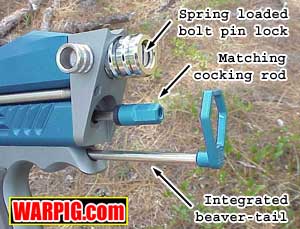 In
the lower half of the receiver are CCM’s valve, hammer, and velocity adjuster.
The velocity adjuster is threaded into the back of the body, and features
a pair of hex head holes to either side of the center cocking rod hole.
This means that velocity adjustment does not require removing the cocking
rod, it can be done instead by simply pulling the cocking block back and
adjusting with a hex wrench. The cocking rod, which extends out of
the rear of the gun, is made of stainless steel, but the knob at its rear
is anodized aluminum to color match the paintgun. The knob features
wrench flats making it easy to remove without damage or surface scratches
if it ever binds into the hammer.
In
the lower half of the receiver are CCM’s valve, hammer, and velocity adjuster.
The velocity adjuster is threaded into the back of the body, and features
a pair of hex head holes to either side of the center cocking rod hole.
This means that velocity adjustment does not require removing the cocking
rod, it can be done instead by simply pulling the cocking block back and
adjusting with a hex wrench. The cocking rod, which extends out of
the rear of the gun, is made of stainless steel, but the knob at its rear
is anodized aluminum to color match the paintgun. The knob features
wrench flats making it easy to remove without damage or surface scratches
if it ever binds into the hammer.
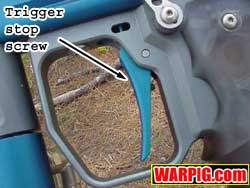 CCM’s
swing grip frame has an angular trigger guard, echoing the J2 body design,
but curves in the rear for comfortable wrist placement. Integrated
into the grip frame is their beaver tail. This guard, required for
tournament play protects the cocking knob from a player pressing it against
their cheek or mask for a velocity boost. The guard is a stylish
hexagonal shape in anodized aluminum on a single stainless steel rod.
The same swing blade style trigger is used for the pump and semi-auto versions,
and includes adjustable trigger stop screws in the trigger. The trigger
frame accepts standard 45 style grips, and the model reviewed featured
Extreme Rage wraparound grips.
CCM’s
swing grip frame has an angular trigger guard, echoing the J2 body design,
but curves in the rear for comfortable wrist placement. Integrated
into the grip frame is their beaver tail. This guard, required for
tournament play protects the cocking knob from a player pressing it against
their cheek or mask for a velocity boost. The guard is a stylish
hexagonal shape in anodized aluminum on a single stainless steel rod.
The same swing blade style trigger is used for the pump and semi-auto versions,
and includes adjustable trigger stop screws in the trigger. The trigger
frame accepts standard 45 style grips, and the model reviewed featured
Extreme Rage wraparound grips.
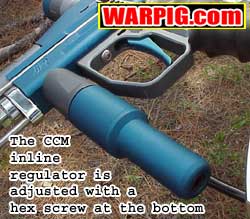 CCM’s
vertical regulator acts as the main regulator for the paintgun, setting
gas pressure to the exhaust valve and thus affecting both operational pressure
and velocity. It is of a straight forward design, and sturdy enough
to play double duty as a foregrip in the semi-auto model. The vertical
ASA into which it connects has cosmetic cuts as well as a hole on the right
hand side to allow for a timing rod when used on a semi-auto.
CCM’s
vertical regulator acts as the main regulator for the paintgun, setting
gas pressure to the exhaust valve and thus affecting both operational pressure
and velocity. It is of a straight forward design, and sturdy enough
to play double duty as a foregrip in the semi-auto model. The vertical
ASA into which it connects has cosmetic cuts as well as a hole on the right
hand side to allow for a timing rod when used on a semi-auto.
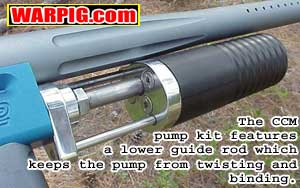 The
main body of the pump is generously sized to serve both as a foregrip and
pump. This is important as the pumping system does not have a forward
latching system or biasing spring, so it must be held forward while firing.
Gentle grooves in its front half allow for an easy grip.
The
main body of the pump is generously sized to serve both as a foregrip and
pump. This is important as the pumping system does not have a forward
latching system or biasing spring, so it must be held forward while firing.
Gentle grooves in its front half allow for an easy grip.
 Few
players today will opt for a pump action model as their main paintgun.
Some people however, like to pick one up as a second paintgun, in order
to force them to use less paint while practicing, or to compete in pump
only tournaments which are growing in areas like Southern California and
Texas. In circuits like the Pan Am, where there is limited paint
use in the 5 man competition, the switch to pump definitely has made CCM
a memorable team and gained more attention for them in magazines and on
web sites. For those considering the move to pump, the J2 represents
a product that both looks good and performs well. It also offers
flexibility in that its pump assembly can be replaced with a pneumatics
block and components to switch over to semi-automatic operation.
While this switch does take a bit of time and expertise, it gives the J2
the ability to function as two markers for the price of one.
Few
players today will opt for a pump action model as their main paintgun.
Some people however, like to pick one up as a second paintgun, in order
to force them to use less paint while practicing, or to compete in pump
only tournaments which are growing in areas like Southern California and
Texas. In circuits like the Pan Am, where there is limited paint
use in the 5 man competition, the switch to pump definitely has made CCM
a memorable team and gained more attention for them in magazines and on
web sites. For those considering the move to pump, the J2 represents
a product that both looks good and performs well. It also offers
flexibility in that its pump assembly can be replaced with a pneumatics
block and components to switch over to semi-automatic operation.
While this switch does take a bit of time and expertise, it gives the J2
the ability to function as two markers for the price of one.