  |
|
 HomePicturesTechnicalTournamentRecreationalFieldsStores HomePicturesTechnicalTournamentRecreationalFieldsStores |
|
|
Beginner InfoNews
And ArticlesLinksResourcesVideoContact
UsSearch |
| |
|
|
HomePicturesTechnicalTournamentRecreationalFieldsStores |
|
|
Beginner InfoNews
And ArticlesLinksResourcesVideoContact
UsSearch |
What
do you think?
|
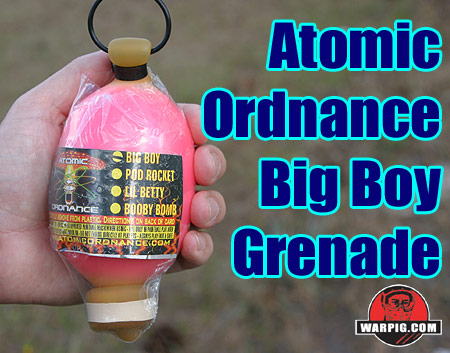
Atomic Ordnance Big Boy By Bill Mills - Photos by Dawn Mills - March 2006 There seems to be a progression among many players. As a new player they may see or hear about a paintball grenade and think it the ultimate weapon with which they can take out the entire opposing team single handedly. When they do get a grenade they soon discover there are not the best tool for every situation, and depending on the grenade they purchased they can be even more disappointed if their grenade fails to go off, or doesn’t mark well or in a large enough area. Since grenades aren’t a part of tournament paintball (aside from Dale Price jokingly lobbing one during an NPPL Super 7 tournament in Denver – it didn’t hit anyone and wouldn’t have counted if it did,) they often don’t get much time in the spotlight, but as some players continue on into scenario play, they may rediscover the fun and surprise of paintall grenades.
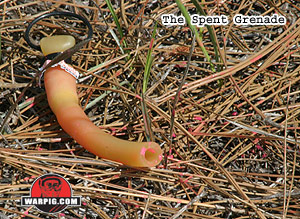
The Big Boy is the flagship product in the Atomic Ordnance line. Like most paint grenades the technology it uses is length of rubber like tubing that is filled, stretching it much like the long narrow balloons used by clowns to sculpt animals. When the paint grenade discharges, the liquid paint fill sprays out of the tube, hopefully marking opposing players.
To minimize the risk of a misfire during shipping and storage, Atomic Ordnance shrink-wraps their paint grenades. This provides a protective “safety” in addition to holding their label and contact information in place. With a translucent tubing, it is easy to see what color fill is in the grenade. What is also noticeable is the smell of the grenade, barely detectable through the rubber tubing and shrink-wrap. Not only does Atomic Ordnance offer bright day-glow colors, but they also add fresh fruit scents to their paint fill.
Atomic Ordnance addressed settling fill by working with food companies who have already solved settling problems for sauces and dressings that are sold in glass jars and would be unappealing to consumers if they separated. The result was a new fill that maintained bright color, good viscosity, and the ability to be stored for months without settling or separating.
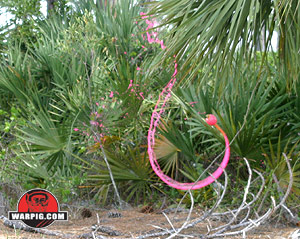
The Big Boy grenade from Atomic Ordinance
proved both easy to use, and reliable in its delivery of paint.
|
| Copyright © 1992-2019
Corinthian Media Services. WARPIG's webmasters can be reached through our feedback form. All articles and images are copyrighted and may not be redistributed without the written permission of their original creators and Corinthian Media Services. The WARPIG paintball page is a collection of information and pointers to sources from around the internet and other locations. As such, Corinthian Media Services makes no claims to the trustworthiness or reliability of said information. The information contained in, and referenced by WARPIG, should not be used as a substitute for safety information from trained professionals in the paintball industry. |
 Atomic
Ordnance paint grenades hit the scene in 2000. In the following years
both the grenades and their fill have seen numerous changes. In 2004,
the father and son team of Duane “Kahuna,” and Mike Bell took ownership
of Atomic Ordnance and put their minds to work at making what they thought
to be a great paint grenade even better.
Atomic
Ordnance paint grenades hit the scene in 2000. In the following years
both the grenades and their fill have seen numerous changes. In 2004,
the father and son team of Duane “Kahuna,” and Mike Bell took ownership
of Atomic Ordnance and put their minds to work at making what they thought
to be a great paint grenade even better.
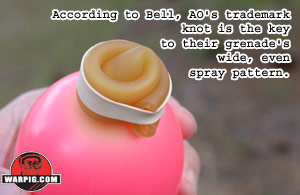 One
problem that has faced many paint grenade users going back to the 1990s
is a simple failure go to off. Many early designs used ball bearings
to block the grenade tubing, and after sitting for some time, often don’t
spray their paint after they are thrown. Having your own paint grenade
thrown back at you can be a less than enjoyable experience. The Atomic
Ordnance design does not use a ball bearing in the tubing. Instead
the spray end of the tube is looped in a special knot, and held in place
with a rubber band.
One
problem that has faced many paint grenade users going back to the 1990s
is a simple failure go to off. Many early designs used ball bearings
to block the grenade tubing, and after sitting for some time, often don’t
spray their paint after they are thrown. Having your own paint grenade
thrown back at you can be a less than enjoyable experience. The Atomic
Ordnance design does not use a ball bearing in the tubing. Instead
the spray end of the tube is looped in a special knot, and held in place
with a rubber band.
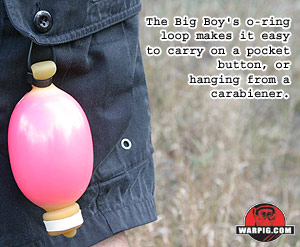 According
to Kahuna, the grenade is stable enough to be carried throughout a game
sans-wrapper, without fear of self-painting, but will reliably activate
after hitting the ground from a height of 12 feet or higher. The
Big Boy grenade features an o-ring loop on its top, which can be clipped
into a D-ring carabiener or looped over a pocket flap button when carried
on the field. For those players not wanting to hit the field with
dangling grenades, Atomic Ordnance released the Pod Rocket, a paint grenade
functionally equivalent to the Big Boy, but a bit longer and narrower so
that it could be carried inside a standard paint pod in a harness.
According
to Kahuna, the grenade is stable enough to be carried throughout a game
sans-wrapper, without fear of self-painting, but will reliably activate
after hitting the ground from a height of 12 feet or higher. The
Big Boy grenade features an o-ring loop on its top, which can be clipped
into a D-ring carabiener or looped over a pocket flap button when carried
on the field. For those players not wanting to hit the field with
dangling grenades, Atomic Ordnance released the Pod Rocket, a paint grenade
functionally equivalent to the Big Boy, but a bit longer and narrower so
that it could be carried inside a standard paint pod in a harness.
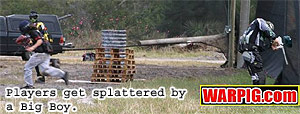
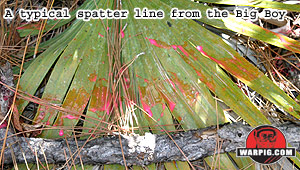
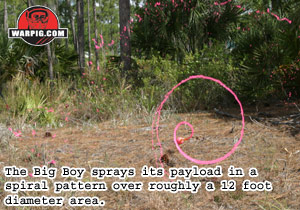 Impressively,
the Big Boy grenades bounced up, spraying paint outward in a spiral pattern.
While many other paint grenades the author has tried would spray their
payload in a single random direction, the Big Boys delivered paint evenly
in a 360 degree zone each time. Their spray pattern covered a circular
area approximately 12 feet in diameter. According to Kahuna, the
spiral wrapped knot they use initiates the proper spin. Of the five
grenades test fired for this review, only one failed to fire on the first
toss, lobbed about 12 feet in the air, and landing on pine-needle forest
litter. Those striking thinner cushioned forest floor, dirt and grass,
all released their payload on the first bounce.
Impressively,
the Big Boy grenades bounced up, spraying paint outward in a spiral pattern.
While many other paint grenades the author has tried would spray their
payload in a single random direction, the Big Boys delivered paint evenly
in a 360 degree zone each time. Their spray pattern covered a circular
area approximately 12 feet in diameter. According to Kahuna, the
spiral wrapped knot they use initiates the proper spin. Of the five
grenades test fired for this review, only one failed to fire on the first
toss, lobbed about 12 feet in the air, and landing on pine-needle forest
litter. Those striking thinner cushioned forest floor, dirt and grass,
all released their payload on the first bounce.
 Some
of the Atomic Ordnance Big Boy features were not as readily apparent as
how they sprayed paint, but of equal importance. Most tube based
paint grenades include instructions, which say they should be shaken before
being thrown. This is because, like with paintballs, it is not uncommon
for the pigments in the paint fill to settle to one side when the grenade
is being stored at the manufacturer, shipped to a warehouse, stored there,
then shipped to a store, and stored some more before finally making it
into a player’s hands.
Some
of the Atomic Ordnance Big Boy features were not as readily apparent as
how they sprayed paint, but of equal importance. Most tube based
paint grenades include instructions, which say they should be shaken before
being thrown. This is because, like with paintballs, it is not uncommon
for the pigments in the paint fill to settle to one side when the grenade
is being stored at the manufacturer, shipped to a warehouse, stored there,
then shipped to a store, and stored some more before finally making it
into a player’s hands.
 Another
hidden problem with many paint grenades is spoilage. One doesn’t
often think about such things, but if the grenade fill is made of components
that may host bacteria, it can spoil, and it is not uncommon for some paint
grenades to mark not only with color, but an unintentional sent – that
of spoiled milk – coming from bacterial growth in the fill.
Another
hidden problem with many paint grenades is spoilage. One doesn’t
often think about such things, but if the grenade fill is made of components
that may host bacteria, it can spoil, and it is not uncommon for some paint
grenades to mark not only with color, but an unintentional sent – that
of spoiled milk – coming from bacterial growth in the fill.
 According
to Kahuna, Atomic Ordnance has squarely addressed this issue as well by
including bacterial inhibitors in the fill, and using sanitation practices
with their handling of the fill that are similar to those used in food
packaging industries. The Big Boy grenades test fired for this review
sat for a few weeks in a room that was not climate controlled, giving them
ample opportunity to sour and or settle. However, when test fired
they produced only evenly mixed, sweet strawberry smelling splatter.
According
to Kahuna, Atomic Ordnance has squarely addressed this issue as well by
including bacterial inhibitors in the fill, and using sanitation practices
with their handling of the fill that are similar to those used in food
packaging industries. The Big Boy grenades test fired for this review
sat for a few weeks in a room that was not climate controlled, giving them
ample opportunity to sour and or settle. However, when test fired
they produced only evenly mixed, sweet strawberry smelling splatter.